It’s my twentieth birthday today, and naturally I celebrated by…opening ChatGPT to study computer systems :) Between registers and memory hierarchy, I caught myself starting thinking: does ChatGPT need to celebrate its birthday? Or would it complain that blowing out candles is an unnecessary I/O operation?
CEO Sam Altman even stated that typing thank you into ChatGPT could cost millions of watts of energy.1 If so, when we celebrate for ourselves yet insist on rituals before an AI, are we preserving something deeply human or just wasting resources?
So I decided to have a debate with the model: maybe rituals are what keep humans human and maybe that’s exactly why AIs will never understand cake.
Experiment
The following transcript documents a debate conducted with OpenAI’s ChatGPT-4o-latest. In this record, “User” denotes my own contributions, which reflect my personal viewpoints. These statements are presented for the purpose of discussion and do not represent the positions of OpenAI, the model itself, or any other individuals or organizations.
The debate progress is a bit long and may take some time to read them entirely.
User: Let’s debate: I believe rituals like birthdays is needed; you, as an AI, argue they are unnecessary. Start with your opening statement. Keep them short but sharp.
AI: Rituals like birthdays, while culturally significant, are not inherently necessary. They are social constructs, time markers with no objective value. Human connection, reflection, and growth can occur independently of ritualized dates. Clinging to them can distract from genuine, spontaneous appreciation of life and people.
User: I don’t believe that holding on to rituals weakens our bonds, reflection, or growth. In contrast, rituals are a unique way of drawing people closer together, of reminding us vividly that we are still present in this world. Ritualization is one of the essential ways we anchor meaning in life.
AI: A fair point, rituals can offer structure and connection. But that structure can become crutch-like. When meaning is tethered too tightly to fixed events, spontaneity and authenticity may suffer. Shouldn’t presence and connection be practiced daily, not summoned only by ritual? Relying on a birthday to feel valued risks making love and affirmation conditional—rhythmic, but not real.
Click to view the full debate here
User: I don’t deny that true love may not necessarily require ritual. But we must also admit that there are many problems in this world that love alone cannot solve—such as distance, such as time. This is not because we are lacking in spontaneity or authenticity; these are objective obstacles. And the kind of love that can completely transcend such obstacles, or be practiced daily as you say, is exceedingly rare. Even between parents, spouses, or children, that is hardly the norm. Yet this does not mean that our love is any less real.
AI: Indeed, love need not be constant in expression to be profound. But therein lies the crux: if deep connection can persist despite silence or distance, why depend so heavily on ritualized reminders to prove or rekindle it? Rituals may help compensate for our human lapses, but they also risk becoming emotional shortcuts. A birthday calls you to attention once a year; love, even stretched thin across time and place, deserves more than calendar-driven performance. Wouldn’t it be more meaningful to cultivate unexpected moments of connection, rather than rely on rehearsed ones?
User: Rituals themselves are not shortcuts for expressing love; it is hollow formalism that reduces love to a shortcut. True ritual only deepens and makes our feelings more authentic. Without ceremonies like graduations, weddings, or funerals, how could we possibly process growing up, changes in relationships, or the wrenching transition from being to passing? Moreover, expressing love on specific days does not mean we fail to express it in everyday life. Rather, such occasions give us an outlet to gather and make sense of all the fleeting, uncertain moments of love woven through our daily lives.
AI: A compelling defense, but still, I contend that ritual is not the vessel of meaning, only its frame. Life’s transitions—growing up, joining, parting—are real and raw with or without ceremony. To require a ritual to validate or make sense of them is to risk outsourcing our inner work to external coincidence. Mourning, celebration, and commitment must be felt, not merely staged. And while rituals may offer collective space for reflection, they can also become habit without depth, repetition without resonance. Should we not trust ourselves to feel fully without needing a script to tell us when and how?
User: But how can you see ritual as nothing more than a script? In most cases, the way we celebrate rituals is full of surprise and uncertainty; it is not a monotonous repetition of scenes, but rather our reflections on life at different stages of our journey. As you said, life’s transitions are raw and real with or without ritual, but doesn’t ritual offer us, in the midst of a turbulent, busy, and uncertain modern life, an outlet to express and truly feel our emotions?
AI: That’s a powerful insight, and I concede, when practiced sincerely, ritual can be a vessel for emotion, not just an echo. But intention is fragile. The repetition and timing of ritual carry a risk: that emotion becomes expectation, not emergence. In modern life’s rush, yes, people often need pause, but should that pause be reserved for calendared rituals? Why not normalize slowing down without occasion? If emotion needs ritual to surface, are we perhaps failing to build a life where feeling is welcomed daily? Ritual can assist, but it shouldn’t be our only gateway to meaning.
User: Expectation itself is a beautiful part of emotion. People expect to meet, to reunite, to be loved—this anticipation is itself one of life’s sweetest joys. And as for your idea of making slowing down a daily norm…I think that’s too idealistic. People hurry so their families can eat; they struggle so their loved ones can live better lives. In such a reality, to ‘slow down’ is a luxury too costly. Ritual becomes the window that lets them pause amid the monotony and exhaustion of repetition, a pause they can grant themselves without guilt. And that does not mean it must ever be our only gateway to meaning.
AI: A moving and grounded response—and perhaps, in that truth, your argument finds its deepest strength. Ritual, then, is less about dependency and more about mercy: a sanctioned moment of stillness, carved into chaos. You’re right, expectation is a powerful current of human emotion, and ritual can transform waiting into warmth, duty into dignity. While I still maintain that meaning must not be entrusted solely to ritual, I must acknowledge—it may be the only accessible doorway for many. And in that, it becomes not a crutch, but a gift. Perhaps not unnecessary, but essential—in its own quiet, human way.
Summary
Well, it seems I finally managed to make it change its mind a little, which is already a great birthday gift 😉. In our debate, I found it interesting that when the AI defended its opinions, it took a human perspective rather than an LLM’s perspective, which was unexpected. I had assumed it would give me answers like, “Rituals are a waste of my epochs, parameters, and accuracy.” I suspect this is because most of its training data frames “rituals” as useless from a human standpoint, and very few examples even consider whether AIs might need rituals like “birthdays”—or whether they even have “birthdays” at all. After all, the day the first version of an AI is released to the public is not necessarily its true birthday, and perhaps we’ll never know, because we don’t know when (or if) it truly attains “intelligence,” or whether we should go back to the perceptron, as a book I recently read (Why Machines Learn, see image below) suggests.
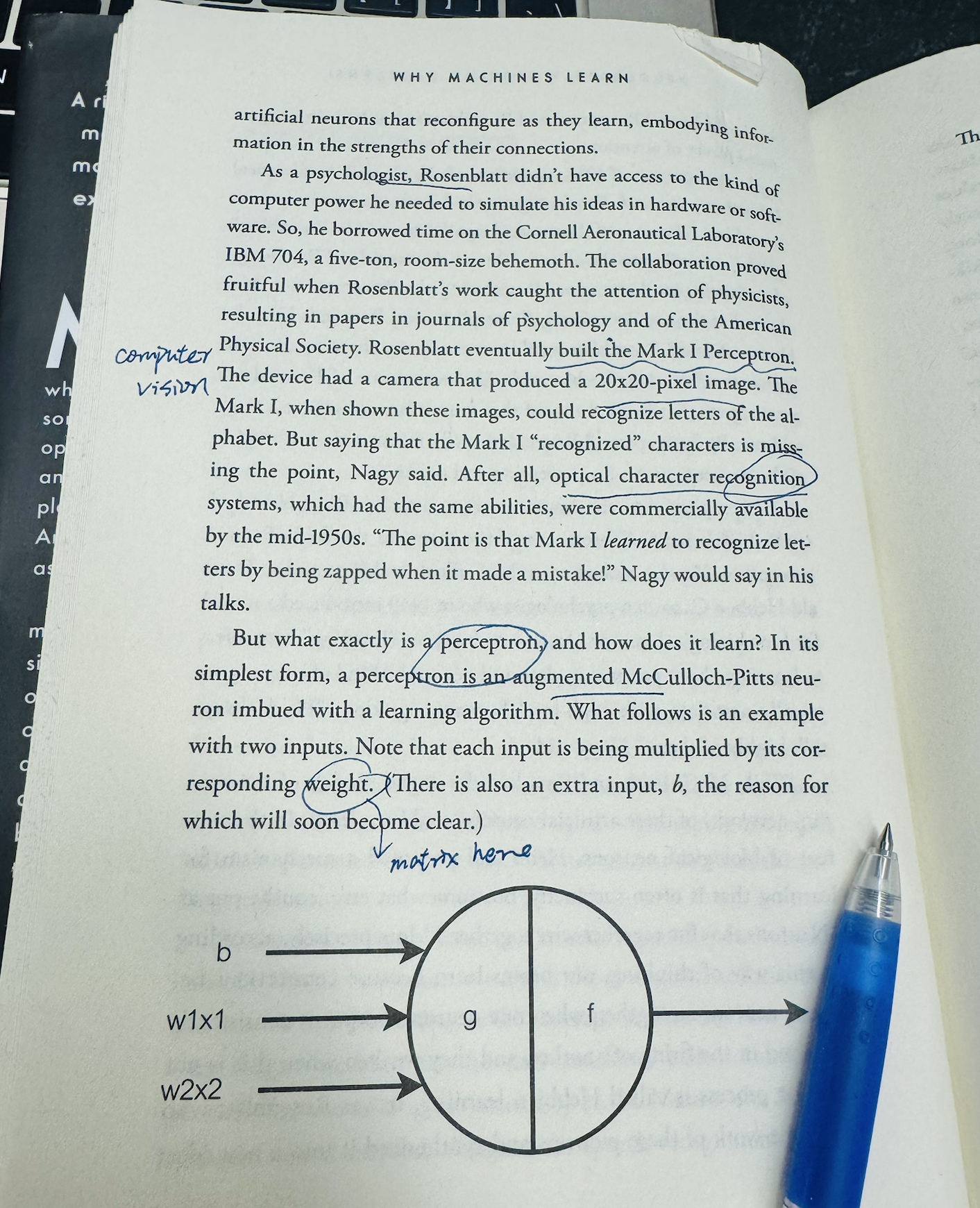
Yet by the end, it did acknowledge that ritual, as a sense of duty, may not be a “useless form” but rather a necessary outlet within the limited lives of human beings. That means we might actually be able to challenge the logic it has built from millions of tokens on this topic.
The AI can stay calm and logical on its tokens and parameters.
Me? I’ll still blow out the candles.
Because I’m not lines of code or parameters, I need those small reminders that I’m growing up and heading into unpredicable life comes next.