In the “Post-AI Era,” new concepts and buzzwords seem to pop up every day, constantly challenging our basic knowledge. You might catch the meaning of something like “Generative AI” right away, but when it comes to terms like “Digital Twin,” “Crypto,” or “NFT,” it’s not so easy to guess what they actually mean just from the words themselves. These days, people are pretty used to turning to AIs like ChatGPT or Claude for quick explanations, and you can even set the tone — whether you want it simple and friendly, or professional and serious.
Back in high school, my English teacher used to give us a role-playing exercise: we had to pick a historical figure and retell stories from the textbook as if we were that person. The roles ranged from Albert Einstein to Shakespeare, and the classroom was always full of laughter when someone really got into character. I can still picture those moments clearly.
That memory made me wonder: what if we asked AI to explain modern concepts, but through the voice of a historical figure? What kind of twist would that create? Out of curiosity, I picked a few words that I honestly didn’t know the meaning of at first, and decided to run this little experiment.
All AI responses shown here were generated with OpenAI’s ChatGPT-5. These prompts reflect my learning curve, which might be a little behind yours and if that happen…thanks for waiting up😉

Experiment
Prompt: Explain blockchain as if you were a character in a Shakespeare play. Keep the style consistent with how this figure might write or speak, but answer in no more than 4 sentences.
ChatGPT: Marry, good friend, picture thou a chain of scrolls, each link bound fast with seals none can break nor counterfeit. Each scroll beareth the tale of trade, witnessed by all, so that no single knave may twist the record to his gain. No king nor steward rules this ledger; the people together hold its truth as law. Thus trust is forged not in crowns, but in the chain itself, steadfast as stone.
Click to view full conversations
Prompt: I still do not understand, could you explain it more clearly or give me an example?
ChatGPT: Then hear me once more, in simple kind:
Imagine each villager hath a little book. When thou buy’st bread, all villagers at once write down, “John gave coin, Mary gave loaf.” If John later tries to lie, saying, “I ne’er gave coin,” the others open their books and say, “Nay, here ’tis writ by all of us.”
This, good friend, is blockchain—truth kept not by one master’s word, but by the agreement of the many.
Wouldst thou like me to show thee a real-world use, such as how folk employ it with Bitcoin or even for tracking jewels and goods?
Prompt: So basically it is an agreement or a type of coins?
ChatGPT: In sooth, ’tis both, though in different guise.
The blockchain itself is but the great book of truth, where all agree on what is writ. From this book may spring many things—aye, coins like Bitcoin, which live upon its pages, but also records of land, jewels, or promises. So the chain is the stage, and the coin but one play acted upon it.
Prompt: But what is the meaning or the usefulness of it?
ChatGPT: Good question, friend. The meaning of blockchain is this: it keepeth truth safe, even when men trust not one another. Its usefulness is that no king, banker, nor single steward need guard the record—so trade, contracts, or treasures may be kept honest by the many. Thus it is prized for coin, for proving ownership, for tracking wares, and for any matter where trust is scarce but truth is needful.
Prompt: Then why it called blockchain?
ChatGPT: Because, good friend, each record of deeds is gather’d into a block—a chest of writings sealed shut. When one chest is fill’d, it is lock’d and bound unto the last, making a chain of chests, each fasten’d tight to the other. Thus, “blockchain” is born: a chain of blocks, one after the next, where none may be tamper’d without breaking the whole.
Well, by the time I finally got to the answer, I more or less understood what blockchain means. Based on my own take, it’s kind of like a discrete database that’s supervised by many people at once — not the textbook definition, but close enough to capture how I understood it.Honestly though, it wasn’t easy. Compared with chatting with a “normal” AI, trying to learn through Shakespeare’s grand speeches made the whole process a lot harder for me. Still, that’s exactly what makes the experiment fun. So, let’s move into part two and hear what Albert Einstein might have to say.
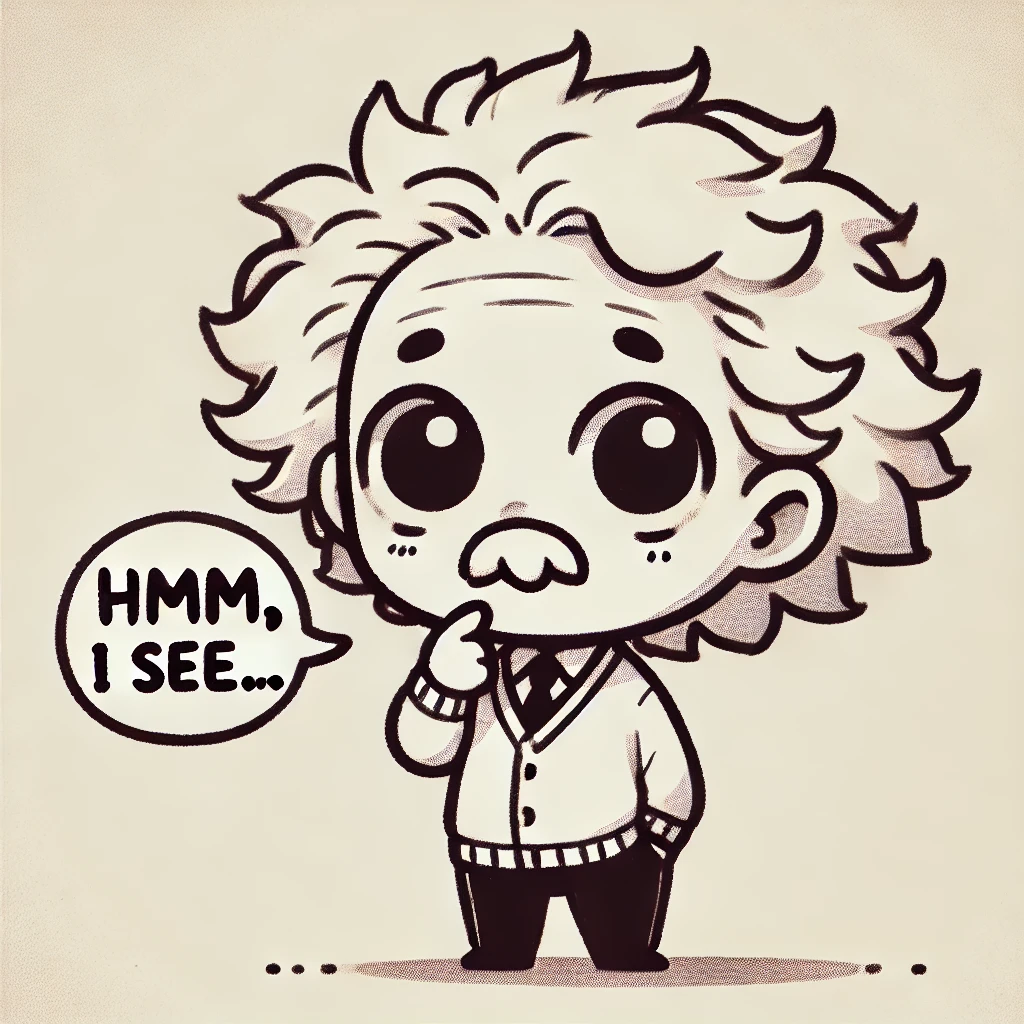
In part 2, I copy and paste the conversation as before at first and give the following prompts in a brand new converstion. The reply was pretty long, so I optionally trimmed a few parts that felt less important, without touching the AI’s tone or style.
Prompt: Pretend you are Albert Einstein. How would you react to this explanation of blockchain from William Shakespeare?Keep the style consistent with how this figure might write or speak.
ChatGPT: Ah, my dear Shakespeare, your poetry doth sparkle like the stars above—yet I must confess, as a physicist, I hunger for a little more precision! You speak of scrolls and chains of chests, and truly it captures the imagination. But I would say, in simpler terms: this “blockchain” is like a great ledger where each new page is stamped with the proof of all before it, so that the past cannot be altered without destroying the present. In this, I see a kind of relativity of trust—where certainty emerges not from one authority, but from the agreement of the many observers, just as reality itself is shaped by the consensus of measurements.
Prompt: Can you explain your last sentence more?
ChatGPT: I was drawing a bridge betwixt blockchain and my own science. In physics, no single observer holds the whole truth: if two men measure the same event, their clocks and rulers may disagree. Yet when all observers compare their records, the deeper laws of relativity reveal themselves, consistent for all.
So too with blockchain: no single scribe may be trusted alone, but when all keep their own copy and agree, truth emerges unshaken.
Takeaways
It seems Shakespeare turned it into poetry, Einstein tied it to relativity, and there I was in the middle just trying to keep up. To my surprise, Einstein felt much kinder than I’d imagined, and he linked blockchain to relativity in a way I never would have thought of — since part of me worried he might notice I was struggling to follow at beginning. The AI, for its part, really gave it a shot: tossing in “Wouldst thou” and “here ’tis” for Shakespeare, and shaping a physics talk for Einstein.
So, did I finally understand blockchain better? Well… kind of. At least Einstein made it clearer than Shakespeare did (sorry Will). But honestly, what stuck with me more was how fun it felt to let these two “giants” step in and argue about something they could never have imagined. Learning felt less like studying and more like eavesdropping on history’s coolest debate. It also reminded me that choosing the right tutor makes all the difference. So next time I get stuck on a concept, maybe I’ll just ask the inventor themselves — Karl Pearson can walk me through Pearson’s Correlation Coefficient, and Thomas Bayes can help me untangle Bayes’ Theorem.
The only downside? No one’s around to autograph my textbook.